


Bringing your baby home is one of life’s most incredible moments. I still remember it clearly. It’s a bubble of pure love, soft blankets, and that unforgettable newborn smell. But let’s be honest, it can also feel like navigating a beautiful, yet completely unfamiliar, land without a map. A maternity nurse is your personal, expert guide for this journey, offering invaluable in-home support right after you leave the hospital.
Their focus is entirely on the well-being of both you and your baby, helping your family establish calm, gentle routines and building your confidence during those critical first few weeks—a time I love to call the “fourth trimester.”
Your Expert Guide Through the Fourth Trimester
Think of a maternity nurse not as someone who takes over, but as an experienced mentor who walks alongside you. They’re there to provide steady, expert support so you can find your own footing as a new parent. I’ve seen firsthand how this transforms the early days.
Their role is quite different from a midwife, who provides clinical care, or a long-term nanny, who focuses on general childcare. A maternity nurse is a specialist for a short-term, intensive period. Their primary goal? To empower you. They bring a wealth of practical experience from caring for hundreds of newborns, helping you understand your baby’s unique cues and build a strong, loving foundation for the future.
Building Confidence and Calm
Having a maternity nurse is about so much more than just an extra pair of hands. It’s about having a reassuring, knowledgeable presence when you need it most. This kind of support is proven to reduce the stress and exhaustion that so often come with the postpartum period. A good approach to this phase often starts before the birth, with self-care practices like a gentle pregnancy massage helping to prepare both mind and body.
By handling overnight feeds, settling a fussy baby, or offering expert breastfeeding guidance, they create the space you desperately need to rest and recover. This allows you to truly focus on bonding with your newborn, transforming what could be an overwhelming time into a period of connection and joy.
This infographic breaks down the core elements of their role perfectly.
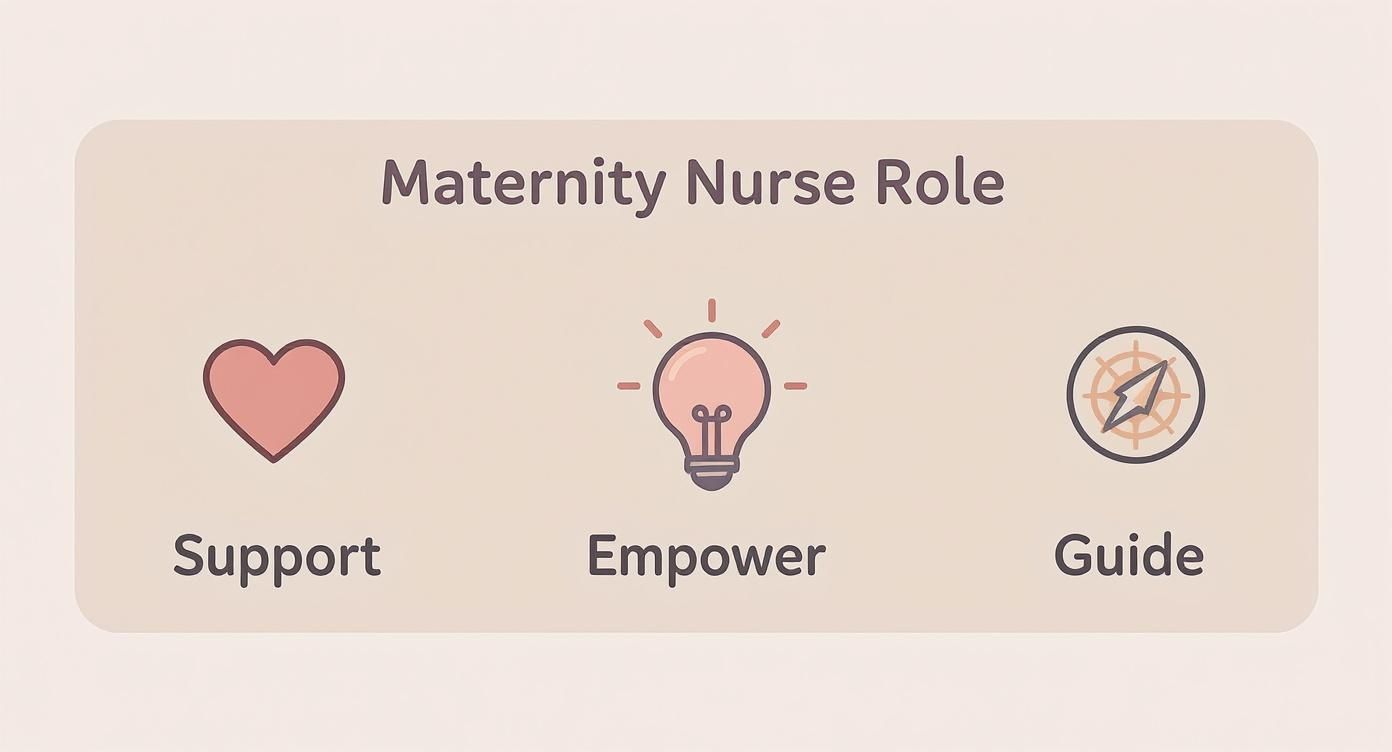
As you can see, their purpose is to support, empower, and guide new families with expert, hands-on care.
Maternity Nurse vs Midwife vs Postnatal Doula at a Glance
It’s easy to get these roles confused, but they each offer unique support. Here’s a quick comparison to clarify the differences.
| Role | Primary Focus | Typical Duties | Qualifications |
|---|---|---|---|
| Maternity Nurse | Baby care, establishing routines, parental education, and postnatal recovery for the mother. | 24-hour care, feeding support (breast & bottle), sleep training, baby laundry, nursery management. | Specialist non-medical maternity qualifications (e.g., MNT, OCN), extensive newborn experience, Paediatric First Aid, DBS check. |
| Midwife | Clinical care for mother and baby during pregnancy, birth, and the immediate postnatal period. | Health checks for mother and baby, wound care (e.g., C-section), medical advice, delivery assistance. | A degree in Midwifery, registered with the Nursing and Midwifery Council (NMC). |
| Postnatal Doula | Emotional, practical, and informational support for the entire family. | Light housework, meal prep, sibling care, running errands, listening and offering emotional support. | Varies; often certified through doula training organisations like Doula UK. Non-medical role. |
This table shows how each professional brings a different, valuable skill set to the postpartum period. A maternity nurse’s expertise lies in creating a smooth transition by focusing on routines and newborn care.
A maternity nurse serves as a mentor, offering encouragement and guidance to build parents’ confidence in their caregiving skills. This support is particularly beneficial for first-time parents navigating the uncharted waters of parenthood.
Ultimately, a great maternity nurse’s job is to work themselves out of a job. After their stay, you are left feeling capable, rested, and fully prepared to embrace your new life with confidence.
To learn more about how our elite agency matches families with the perfect support, you can explore our dedicated services for hiring experienced maternity nurses.
A Day in the Life With a Maternity Nurse
To really get to the heart of what a maternity nurse does, it helps to see their work through the gentle rhythm of a day and night. This isn’t just about a list of tasks; it’s a seamless blend of expert care, quiet observation, and unwavering emotional support. Let’s walk through a typical 24 hours to see how they can transform what might be a chaotic time into a period of calm and connection.
The day often begins before the sun rises, in the quiet stillness of the early morning. While you are getting a few more hours of precious, uninterrupted sleep, your maternity nurse is already up with the baby.
This is a time for gentle, expert care. After a quick nappy change, she’ll settle the baby for their feed. If your baby is bottle-fed, she prepares the formula to the perfect temperature. If you’re breastfeeding, she’ll quietly bring the baby to you, helping you get comfortable and ensuring a good latch before discreetly leaving you to bond.
Morning Support and Routine Building
As you wake, you step into a calm atmosphere. The maternity nurse has likely already sterilised bottles, tidied the nursery, and maybe even put on a load of the baby’s laundry. Her quiet efficiency means you can start your day focusing on your own recovery and enjoying breakfast, not tackling a mountain of chores.
This is when the teaching side of her role really shines. I’ve seen nurses show a new father the best way to bathe his baby, turning what could be a nerve-wracking task into a confident, bonding moment. Or perhaps she’ll discuss your baby’s feeding patterns, explaining the subtle hunger and fullness cues that are so easy to miss when you’re exhausted.
A maternity nurse’s expertise is built on years of hands-on experience. They know that every baby is an individual and tailor their approach accordingly.
- Observation: She might notice the baby seems a bit unsettled and suggest trying different winding techniques.
- Guidance: She can offer practical tips for managing common issues like reflux or colic, providing solutions that bring immediate relief.
- Empowerment: Crucially, she explains the why behind her actions, passing on her knowledge so you feel capable and informed long after she’s gone.
This collaborative approach is what sets a true maternity nurse apart. They aren’t just there to do things for you; they are there to teach and guide you.
Afternoon Rest and Recovery
The afternoon is a vital window for a new mother’s recovery. While your baby naps peacefully—often thanks to the gentle settling techniques the nurse has established—she makes sure you are also resting. This might be as simple as bringing you a nutritious lunch and a cup of tea, running a bath, or just being a listening ear.
Postpartum recovery is as much emotional as it is physical. The hormonal shifts, coupled with severe sleep deprivation, can feel immense. Having a compassionate professional to talk to is invaluable. A recent report from MBRRACE-UK highlighted that between 2021 and 2023, the maternal death rate was 12.82 per 100,000 women, a stark reminder of the critical need for high-quality postnatal care.
A maternity nurse provides a safe space for new mothers to voice their concerns, ask questions without judgement, and process the enormous changes they are experiencing. This emotional support is just as vital as the practical help.
They also act as a gentle gatekeeper, handling visitors or phone calls so you can truly switch off. Their entire focus is on creating a peaceful bubble where your new family can heal and bond without the usual pressures of the outside world.
The Quiet of the Night
As evening falls, the nurse helps establish a calming bedtime routine—perhaps a warm bath, a gentle massage, and a final feed. Then, she takes over for the night, giving you the incredible gift of a full, restorative night’s sleep. For many families, this is the single most significant benefit of hiring a maternity nurse.
Overnight, she tends to the baby’s every need. She’ll handle all the feeds, changes, and resettling, meticulously logging the details so you are fully in the loop when you wake.
This unbroken sleep isn’t a luxury; it’s essential for physical healing, mental wellbeing, and the emotional resilience needed for parenthood. By shouldering the night-time duties, the maternity nurse gives you the rest you need to wake up feeling refreshed, positive, and ready for the day ahead.
The Real Benefits of Postpartum Support
A maternity nurse offers something far more valuable than just an extra pair of hands—they provide peace of mind. While their practical skills are undeniable, the true benefit of their support shines through in the quiet, unseen moments. It’s in the calm that settles over your house and the confidence that blossoms in you as new parents.
Hiring a maternity nurse isn’t about outsourcing parenthood. Think of it instead as a foundational investment in your family’s long-term wellbeing. By expertly navigating the logistical and emotional whirlwind of newborn care, they create the space for you to focus on what really matters: bonding with your baby and each other.
A Buffer Against Postpartum Challenges
The journey into parenthood is one of life’s biggest shifts, and it can bring unexpected mental and emotional hurdles. In those early weeks, restorative sleep isn’t a luxury; it’s a clinical necessity for recovery. A maternity nurse’s presence is a direct antidote to the exhaustion that can magnify stress and anxiety.
By taking over night feeds and settling the baby, they give you the gift of uninterrupted sleep. This single act creates a powerful ripple effect, significantly lowering the risk of postpartum depression and anxiety. A well-rested mind is simply more resilient, patient, and better equipped to handle the daily demands of a newborn. You can learn more about how overnight professionals work in our detailed guide to night nurses for newborns.
Fostering Deeper Family Bonds
When you aren’t running on empty or worrying if you’re “doing it right,” you are free to simply be with your baby. A maternity nurse’s support allows you to be fully present for all those fleeting, magical first moments.
This support strengthens the parental partnership, too. With an expert managing the newborn’s schedule, you have more energy for one another. You can share the joys of your new baby without the intense strain that severe sleep deprivation often puts on a relationship.
- Mother’s Recovery: You can focus on your physical healing, knowing the baby is in expert hands.
- Partner’s Involvement: Your partner can bond with the baby confidently, guided by a professional.
- Couple’s Connection: You have time to reconnect, strengthening your partnership as you grow into a family.
This supportive environment is crucial for building a strong, happy family unit right from the start.
“A maternity nurse provides a safe space for new mothers to voice their concerns, ask questions without judgement, and process the enormous changes they are experiencing. This emotional support is just as vital as the practical help.”
The importance of high-quality postnatal care cannot be overstated. A recent report highlighted that between 2021 and 2023 in the UK, the maternal death rate was 12.82 per 100,000 women, a sobering figure that underscores the need for attentive, professional support during the postpartum period. You can learn more about these important maternal health findings and the factors influencing these outcomes.
An Investment in Lifelong Confidence
Ultimately, the greatest gift a maternity nurse gives is empowerment. They don’t just care for your baby; they teach you how to understand your baby’s unique needs, cues, and personality. This knowledge builds a deep-seated confidence that stays with you long after their time with you ends.
They provide hands-on coaching for everything from bathing and swaddling to establishing gentle, sustainable routines. To help with a smooth physical recovery, a maternity nurse often guides new mothers in using an essential postpartum recovery toolkit. By the time they leave, you feel capable, prepared, and secure in your own parenting abilities, ready to embrace the future with your new family.
What to Look for in a Maternity Nurse
Choosing a maternity nurse is a deeply personal decision. You’re not just hiring an employee; you’re inviting a professional into your home during one of the most vulnerable and precious times of your life. Finding the right fit goes far beyond a simple CV – it’s about establishing trust, feeling a genuine connection, and sharing similar values.
The best maternity nurses are a unique blend of impeccable qualifications and a calming, reassuring presence. Think of them as a mentor for your new family, someone whose experience will bring you peace of mind and build your confidence as parents.
Essential Qualifications and Vetting
First things first, there are some non-negotiables that guarantee the safety and wellbeing of your newborn. Any professional you consider must have a solid foundation of certifications and background checks. These are the absolute building blocks of trust.
A top-tier maternity nurse will always have:
- An Enhanced DBS Check: This is a mandatory criminal record check, giving you complete assurance that they are safe to work with children.
- Paediatric First Aid Certification: They must be fully up-to-date on life-saving skills, including infant CPR, so they can handle any emergency with calm efficiency.
- Specialised Newborn Care Training: Look for qualifications from recognised institutions like MNT (Maternity Nurse Training) or OCN (Open College Network). These programmes cover everything from lactation support to managing common issues like colic and reflux.
These certifications are your baseline for professionalism and safety. A good agency will have already vetted all these credentials for you, saving you a great deal of time and worry.
The Power of Hands-On Experience
While qualifications are vital, there’s simply no substitute for extensive, hands-on experience. A truly exceptional maternity nurse has supported hundreds of families, encountering a vast range of situations that no textbook can ever fully prepare you for.
The real value of a seasoned maternity nurse lies in their ability to remain calm and confident in any situation, drawing on years of experience to guide you through challenges with grace and expertise.
This deep well of practical knowledge is what allows them to offer nuanced, effective solutions tailored to your baby. This is especially critical if you’re expecting multiples, have a premature baby, or are navigating specific medical concerns. An experienced professional brings a toolkit of tried-and-tested techniques to manage sleep, feeding, and settling for babies with unique needs.
Philosophy of Care and Personal Connection
Beyond the paperwork and the years of experience lies what is arguably the most important factor: the personal fit. You need to find someone whose approach to care aligns with your own parenting style. Are you hoping to follow a clear routine, or do you lean towards a more baby-led philosophy? A great maternity nurse is adaptable and will support your choices, not impose their own.
During the interview, pay close attention to their personality and how they communicate. You should feel completely comfortable asking them anything, no matter how small it seems. They should be a patient teacher, an empathetic listener, and a source of unwavering calm.
The growing diversity within the UK’s nursing workforce is a huge advantage here. As of March 2025, 32.5% of registrants on the Nursing and Midwifery Council register are from Black, Asian, and minority ethnic backgrounds. This diversity enriches the profession, making it easier for families to find a professional who is culturally sensitive and understands their unique family dynamics. You can find more details about the UK’s nursing workforce statistics to see this positive trend for yourself.
Ultimately, the right maternity nurse will feel like a natural extension of your family—a supportive, knowledgeable presence who empowers you to become the confident parents you were always meant to be.
How to Hire the Right Maternity Nurse
Finding the perfect maternity nurse can feel like a huge undertaking, but it doesn’t have to be overwhelming. When you break it down into simple, practical steps, the process becomes much clearer and far less stressful. This isn’t just about ticking boxes on a CV; it’s about finding a warm, trusted professional to welcome into your home during one of life’s most precious and personal moments.
The real goal is to find someone who just clicks with your family’s personality and specific needs.
That’s where a reputable, elite agency like Superstar Nannies makes all the difference. We take care of the exhaustive vetting, reference checks, and background screening, giving you the peace of mind to focus purely on finding that perfect personal connection.
The Initial Consultation: Defining Your Needs
Everything starts with a simple chat. Before we can find the right person for you, we need a crystal-clear picture of what you’re looking for. A great agency will walk you through this, asking the right questions to help you pinpoint your family’s unique requirements.
Think about these key areas:
- Your Ideal Support: Are you imagining 24-hour care for the first six weeks, or is your main priority getting restorative sleep with overnight support?
- Specific Experience: Are you expecting twins or triplets? Or perhaps your baby has a known medical issue, like reflux, that needs a specialist’s touch?
- Your Parenting Philosophy: Do you lean towards a structured, routine-led approach, or are you more comfortable with a flexible, baby-led style? Being upfront about this ensures we find a professional who will champion your choices.
This first step is all about creating a detailed brief. The more you can tell us about your hopes and expectations, the easier it is for us to present you with candidates who feel like a fantastic match right from the start.
Reviewing Candidate Profiles
Once we understand your needs, we’ll send you a handpicked selection of profiles from our most highly qualified maternity nurses. This is your chance to look beyond the qualifications and get a real sense of each candidate’s personality and professional story.
Each profile paints a complete picture, covering their credentials, a detailed work history, and verified references from families they’ve previously supported. Pay close attention to the length and type of their past bookings—a history of long-term placements and glowing testimonials is always a brilliant sign of a top-tier professional. Your goal here is to shortlist the individuals whose experience and ethos really speak to you.
Conducting Meaningful Interviews
The interview is where the magic happens. It’s where you discover if a candidate is truly the right fit for your home. This is your opportunity to ask questions that go beyond their CV to reveal their personality, communication style, and their whole philosophy on newborn care. You’re looking for more than just an expert; you need a calming, reassuring presence.
A maternity nurse acts as a mentor, offering encouragement and guidance to build your confidence as new parents. The interview should feel less like a formal interrogation and more like a conversation with a trusted guide.
To get the most from your interviews, prepare questions that dig into how they handle real-life situations. Think about scenarios that matter most to you and simply ask them how they would approach them.
Here are a few areas you could explore:
- Approach to Routines: “Could you walk me through how you typically help a family establish a feeding and sleeping routine?”
- Handling Challenges: “What’s your approach to settling a particularly fussy or colicky baby?”
- Supporting Parents: “How do you support a new mum who might be struggling with breastfeeding or just feeling overwhelmed?”
- Communication Style: “How do you like to keep parents updated throughout the day and night?”
These kinds of questions open the door to a much deeper understanding of their methods and personality. For a more complete list, we’ve put together a guide with the most leading questions to ask before hiring a maternity nurse to help you feel completely prepared.
Ultimately, you have to trust your gut. The right maternity nurse will make you feel heard, supported, and confident. By following a clear process and partnering with an agency you trust, you can move forward knowing you’re making the best possible choice for your new family.
Answering Your Questions About Maternity Nurses
Deciding to bring a maternity nurse into your home is a big step, and it’s completely normal to have a few practical questions. This is where we get down to the nitty-gritty. Think of this as your guide to the logistics, making sure you have all the information you need to move forward with confidence.
Let’s walk through the most common queries we hear from families just like yours.
How Much Does a Maternity Nurse Cost in the UK?
Understanding the investment is, of course, a crucial first step. Maternity nurses are highly skilled, self-employed professionals, and what they charge can vary based on a few key things. It helps to see this not just as a cost, but as a direct investment in your family’s health and happiness during a truly unique time.
So, what influences the cost?
- Experience: A nurse with decades of experience under her belt, especially with twins, triplets, or premature babies, will naturally command a higher rate.
- Location: As you might expect, rates in London and the South East are generally higher than in other parts of the UK, reflecting the cost of living.
- Number of Babies: Caring for twins or triplets is a more intensive role, and the rate will be adjusted to match that extra work.
In the UK, you can typically expect rates to fall somewhere between £275 to over £400 for 24-hour cover. If you don’t need round-the-clock support, daily rates are also an option. It’s also worth remembering that the agency’s fee for finding and placing your perfect nurse is usually separate from her salary.
When Should I Book a Maternity Nurse?
Timing is everything. The very best, most sought-after maternity nurses get booked up months, sometimes even a year, in advance. To give yourself the best possible choice of candidates, it’s always a good idea to start your search early.
We usually recommend families begin looking around the 20-week mark of the pregnancy. This gives you plenty of breathing room to chat with an agency, look over different profiles, interview a few people, and secure your preferred professional without any last-minute stress. A typical booking can be for anything from a couple of weeks to several months, with the average being between six and twelve weeks – it’s all built around what your family needs.
What Is the Difference Between a Maternity Nurse and a Night Nanny?
This is a really common point of confusion, but the two roles are actually quite different. While both offer fantastic support, their focus and the scope of their work aren’t the same. Getting this straight helps you choose exactly the right kind of help for your family.
A maternity nurse is a mentor and a guide for the whole family, focused on empowerment and establishing long-term routines. A night nanny is a specialist focused solely on giving parents the gift of sleep.
Here’s a simple way to think about it:
- A Maternity Nurse: Offers comprehensive, often 24-hour support. Her role is incredibly broad, covering everything from newborn care and building a solid routine, to supporting a mother’s physical recovery and giving new parents hands-on coaching.
- A Night Nanny: Is all about the overnight care of your baby. Her main goal is to handle all the night-time feeds, nappy changes, and settling, so that you can get a full, uninterrupted night’s sleep. She typically doesn’t provide the wider daytime support or parental education a maternity nurse does.
What Are the Living Arrangements for a Maternity Nurse?
Being clear about living arrangements from the start is key to making sure everyone has a comfortable and positive experience. These details are always discussed and agreed upon during the hiring process and are formalised in the contract.
For a 24-hour booking, the family provides the maternity nurse with her own private room. This is really important, as it gives her a quiet space to rest during her daily break (usually 3-4 hours) and to sleep when she’s off duty. For a nightly booking, the nurse will often stay in the nursery with the baby so she can be right there the moment they stir.
It’s reassuring to know that the UK’s nursing and midwifery workforce is growing, ensuring there’s a strong pool of qualified professionals. As of March 2025, the Nursing and Midwifery Council (NMC) reported a record 853,707 professionals on its register, up 3.3% from the previous year. This growth is great news for families looking for high-quality care. You can read more about the latest NMC registration data to get a better sense of these trends.
At Superstar Nannies, we specialise in matching exceptional families with world-class maternity nurses who provide incredible support, expertise, and peace of mind. We handle every single detail of the vetting and placement process, so you can focus on finding the perfect professional to welcome into your home.
Discover how our elite maternity nurse placement service can support your family