


When you decide to hire a professional nanny, you’re not just bringing someone into your home to care for your children—you’re officially becoming an employer. This transition comes with a set of legal responsibilities, and arguably the most crucial is securing the right insurance for nanny employment. This isn’t just a box-ticking exercise; it’s an essential safeguard for your family, your assets, and the professional you’re entrusting with your children’s well-being.
Why Nanny Insurance Is an Essential Safety Net for Your Family

Think of nanny insurance the same way you think about your home insurance. You hope you’ll never need it, but it’s there to shield you from the financial and emotional fallout of an unexpected event. The same logic applies here. By employing a nanny, you create a workplace within your home, and with that comes a new layer of risk. Accidents, however unlikely they seem, can happen. A simple slip on a freshly mopped floor or a more serious injury while lifting a child could leave you, as the employer, legally and financially liable. Without the proper cover in place, your family could be facing substantial costs for legal fees, medical expenses, and compensation claims.
The Real Risks of Being Uninsured
Choosing to go without the correct insurance exposes your family to tangible risks. The most obvious is a claim following a workplace accident. If your nanny gets hurt while on duty, they could be entitled to compensation, and the costs can quickly become overwhelming. But it’s not just about accidents. Disputes over employment terms or unexpected disagreements can escalate into legal challenges. The right insurance policy often includes access to legal advice and can cover the costs if things turn contentious, protecting your family from unforeseen financial strain.
Protecting your family and your nanny isn’t just about meeting a legal obligation. It’s about building a professional relationship founded on trust, security, and mutual respect. The right insurance is the bedrock of that partnership.
Building a Foundation of Trust
Taking the time to arrange proper insurance for nanny employment speaks volumes. It shows your nanny that you’re a responsible, professional employer who genuinely cares about their well-being. It’s a clear signal that you are committed to providing a safe work environment, and that kind of reassurance helps build a strong, positive relationship from the very beginning. Getting to grips with your obligations is the first step towards a smooth and stress-free employment relationship. To understand the specifics, you can learn more about insurance for nannies in our detailed guide. Putting this framework in place correctly from the start provides complete peace of mind for everyone.
Employers’ Liability Insurance: Your Legal Duty Explained

When you hire a nanny, you become an employer. With that role comes a list of responsibilities, and right at the top is securing Employers’ Liability Insurance. This isn’t just a smart idea—in the UK, it’s a non-negotiable legal requirement. It’s the first and most critical piece of the puzzle you must have in place from day one. This specific insurance for nanny professionals is designed to protect you if your nanny gets ill or is injured because of the work they do for you. If an accident happens in your home while they’re on duty, this policy is what covers any compensation claims and the legal costs that come with them. A common mistake is assuming your home insurance has you covered; it almost certainly doesn’t. You need a dedicated Employers’ Liability policy to be legally compliant and properly protected.
What Does Employers’ Liability Insurance Cover?
Even in the safest homes, accidents can and do happen. Employers’ Liability Insurance is designed to step in when an incident is directly linked to your nanny’s job. Here are a few real-world examples:
- Slips, trips, and falls: Your nanny slips on a wet kitchen floor or trips over a toy left on the stairs, breaking an arm.
- Lifting injuries: They strain their back while lifting your toddler into a car seat or carrying a heavy buggy up a flight of steps.
- Accidents during play: While in the garden, your nanny is injured by faulty play equipment.
In any of these scenarios, if your nanny makes a successful claim, the policy would pay the compensation awarded, shielding your personal assets from what could be a substantial financial hit.
Employed vs. Self-Employed: A Critical Distinction
Getting your nanny’s employment status right is absolutely vital. If you set their hours, tell them what to do, and pay them a regular salary through PAYE, they are without a doubt your employee. This relationship is what triggers the legal requirement for Employers’ Liability Insurance. A self-employed childcarer is a different story; they typically work for several families, set their own terms, and are responsible for their own insurance. However, the vast majority of nanny arrangements in the UK are direct employment. Misclassifying your nanny can lead to serious legal and financial trouble, so it’s a detail you can’t afford to overlook. It’s just as important as ensuring they have the right background checks, which you can learn about in our guide to CRB checks for working with children.
Meeting the Legal Minimum and Beyond
Under UK law, any family that directly employs a nanny must hold a policy with a minimum cover of £5 million. This rule applies as soon as you pay your nanny more than £123 per week. While £5 million is the minimum, many insurance and legal experts strongly advise getting a policy with a higher limit—often £10 million. For high-net-worth households, this extra layer of protection provides complete peace of mind, ensuring you’re insulated from any eventuality.
The penalties for not having this cover are steep. HMRC can fine you up to £2,500 for every single day you are uninsured. It’s a clear sign of how seriously the government takes this obligation.
To get a better grasp of your responsibilities, it can be helpful to understand the wider concepts of liability insurance for contractors, as many of the same principles apply. Getting this right from the start proves you are not only compliant with the law but also a responsible and caring employer.
The True Financial Picture of Employing a Nanny
When you decide to hire a nanny, the figure you agree on for their pay is really just the starting point. To be a responsible, law-abiding employer, you need to understand the full financial picture. This means understanding your obligations for tax, National Insurance (NI), and pension contributions—all of which are vital for your insurance for nanny employment to be valid. Thinking about these “on-top” costs gives you the full story and shows why professional payroll management isn’t just a nice-to-have, but an absolute must. The total outlay is a big part of your household budget, and our guide on the costs of a nanny can help you map it all out.
Demystifying Gross Pay and Employer Contributions
The salary you discuss with your nanny should always be the gross figure—that’s the amount before any tax or other deductions are taken out. From that number, you’ll need to budget for several extra costs that are your legal responsibility as an employer. The main additions to the gross salary are:
- Employers’ National Insurance (NI) Contributions: A mandatory payment you make directly to HMRC, calculated as a percentage of your nanny’s earnings.
- Workplace Pension Contributions: If your nanny is eligible for auto-enrolment (and most are), you are legally required to pay into their pension scheme.
- Payroll Administration Fees: Using a specialist nanny payroll service is the smartest way to ensure every calculation is spot-on and every payment is made on time.
Getting any of this wrong can lead to serious penalties from HMRC. Worse still, it could potentially invalidate your insurance policies if your employment records aren’t in order.
Why Accurate Payroll is Fundamental to Your Insurance
Your Employers’ Liability Insurance is completely dependent on the formal employment relationship you have with your nanny. That relationship is proven through one thing: official, accurate payroll records. If you ever needed to make a claim, your insurer would immediately ask for proof that your nanny is a legitimate employee. That proof is found in payslips, HMRC filings, and pension contribution records. Running inaccurate or non-existent payroll opens you up to two huge risks:
- Invalidating Your Insurance: If an insurer discovers you haven’t been meeting your legal obligations as an employer, they could refuse to pay a claim. That would leave you personally responsible for all the costs.
- Legal Trouble with HMRC: Getting your calculations for tax, NI, and pension wrong can result in hefty fines and demands for back-payments.
Professional payroll management and comprehensive insurance are two sides of the same coin. They are the twin pillars that support a compliant, responsible, and stress-free employment relationship.
Thinking Beyond the Legal Minimum
Employers’ Liability Insurance is the bedrock of your legal duties as a household employer, but it’s just the starting point. Think of it like building a house: the law requires you to lay the concrete foundation, but you still need walls and a roof to create a safe home. The other policies we’ll discuss are those crucial additions, designed to protect your family from the real-world risks that can pop up. Getting this extra coverage isn’t just about protecting your finances. It’s about building a professional, secure, and supportive environment for the person looking after your children. When you go beyond the bare minimum, you show a genuine commitment to your nanny’s well-being, which is the fastest way to build lasting loyalty and trust.
Protecting Against Incidents with the Public
Imagine your nanny is at the park with your children and your child accidentally knocks over another person’s hot coffee, causing a burn. This is precisely what Public Liability Insurance is for. While Employers’ Liability covers your nanny, Public Liability protects you from claims made by other people – ‘third parties’ – for injury or damage. A self-employed childcarer is required to have their own policy, but for employers, it’s a very wise addition to have, especially when your nanny and children are frequently out and about in public.
Making Sure Car Journeys are Properly Insured
If your nanny will be driving your children, whether it’s in your car or their own, getting the motor insurance right is completely non-negotiable. A standard personal car policy simply won’t cut it for work-related driving.
- If your nanny uses your car: You must add them as a named driver to your policy. Without it, your insurance could be void if they have an accident.
- If your nanny uses their own car: Their personal policy needs to be upgraded to include ‘business use’ cover. This specific class of insurance covers the use of a personal vehicle for work purposes.
As the employer, the responsibility falls on you to check that the correct motor insurance is in place before your nanny drives your children anywhere. We always recommend asking for a copy of their insurance certificate to keep on file for your own peace of mind.
Offering Personal Accident Cover as a Valued Perk
Offering a Personal Accident Insurance policy is a fantastic way to go above and beyond your legal obligations. This type of policy provides a financial payment if your nanny suffers an accidental injury – whether it happens at work or on their own time – helping them cover their bills if they’re unable to work. Including this in their benefits package shows you care about them as a person, not just an employee. In a competitive market, thoughtful benefits like this can be the deciding factor for attracting and keeping the very best childcare professionals.
A Step-by-Step Guide to Getting the Right Nanny Insurance
Sorting out the right insurance for your nanny can feel like navigating a maze, but it doesn’t have to be overwhelming. If you break it down into a few manageable steps, you can create a secure and supportive environment for your new employee right from the start. First things first, you need a clear picture of what you’re actually insuring against. It’s all about looking at your nanny’s employment contract and the real-world duties they’ll be performing day-to-day. This isn’t a one-size-fits-all situation; it’s about mapping out the specific risks that apply to your family.
Step 1: Figure Out Your Family’s Unique Needs
Before you talk to an insurer, you need to know exactly what cover you need. Every family is different, and so is every nanny’s role. Start by asking yourself a few key questions:
- Driving Duties: Will your nanny be driving the children? If so, are they using your car or their own? The answer here has a direct impact on your motor insurance.
- Travel: Is your family often on the move? International or even domestic travel brings a new set of risks that standard policies might not cover.
- Daily Activities: What does an average day look like? Trips to the park, swimming lessons, or attending playgroups all have different risk profiles compared to just staying at home.
Answering these questions gives you a clear brief to take to an insurance provider. It ensures the conversation is productive and that you end up with a policy that genuinely fits your circumstances. This kind of risk assessment should be a core part of any comprehensive plan for hiring a nanny.
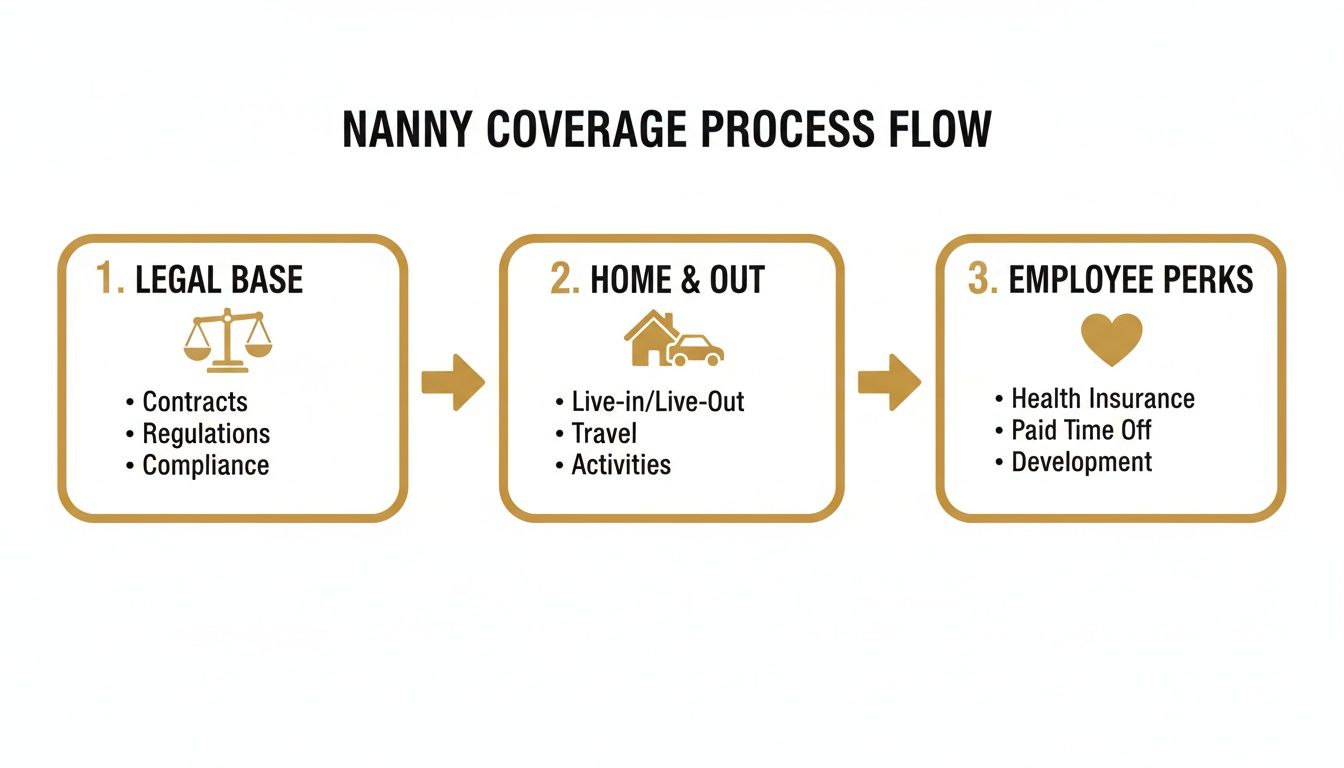
As you can see, it’s about building a complete package of protection, starting with what’s legally required and then adding cover that gives both you and your nanny peace of mind.
Step 2: Find the Right Provider
Once you know what you’re looking for, it’s time to find the right people to provide it. In the UK, families have a few solid options for arranging nanny insurance:
- Specialist Nanny Payroll Providers: Companies like Nannytax often bundle Employers’ Liability Insurance right into their payroll services. This is probably the most straightforward, all-in-one solution.
- High-Value Home Insurance Policies: If you have a premium home insurance policy, check if it includes an add-on for domestic staff. You’ll need to speak directly with your provider to get the details.
- Independent Insurance Brokers: For more complex situations or for UHNW households, a good broker is invaluable. They can source bespoke policies that cover every possible angle.
Step 3: Ask the Right Questions
To be certain you’re fully protected, you have to ask specific questions about any policy you’re considering. Don’t hesitate to get into the nitty-gritty to understand precisely what’s covered and, just as importantly, what isn’t.
Getting complete clarity before you sign anything is crucial. Asking the right questions now can save you from huge headaches down the line and ensure the policy you choose is truly robust enough for your family.
Here are the essential questions to put to any potential insurer:
- What is the exact limit for the Employers’ Liability cover? (You should be looking for at least £10 million).
- Does the policy cover accidents or incidents that happen outside our home?
- What’s the process for making a claim?
- Are there any specific exclusions in the small print I should be aware of?
- Does the policy give me access to a legal advice helpline for employment-related questions?
Getting clear, confident answers to these questions is the final piece of the puzzle. It’s how you can be sure you’ve secured the right protection and can relax, knowing you’re fully covered.
Becoming a Confident and Compliant Employer
Hiring a nanny can feel like a big leap, but getting the right insurance for nanny professionals sorted is the final piece of the puzzle. It’s what turns any lingering uncertainty into solid confidence, cementing the professional and respectful relationship you have with the person caring for your children. When you take the time to understand your legal duties, you’re not just ticking boxes; you’re building a foundation of trust and security. It all starts with the absolute must-have of Employers’ Liability Insurance, but also means understanding the full financial picture, including those all-important tax and National Insurance contributions.
Key Takeaways for Protecting Your Family
Being a great employer is about action, not just words. Here are the key things to remember:
- Legal Compliance is Non-Negotiable: Employers’ Liability cover isn’t a choice—it’s a legal requirement that shields you from huge financial risks.
- Financial Clarity is Everything: Be clear on the true cost of employment, including tax, NI, and pension contributions, to keep your insurance policy valid.
- Full Coverage Brings Peace of Mind: Looking into extra policies, like motor and public liability insurance, builds a complete safety net around your family and your nanny.
In the end, arranging the right insurance is about so much more than fulfilling a legal duty. It’s a genuine investment in creating a secure, positive, and lasting relationship with your nanny, making sure your home is the safe and supportive workplace it should be.
To really get to grips with being a compliant and confident employer, you might want to look into comprehensive HR support for small businesses. Expert guidance can make navigating the various challenges of employment feel much less daunting, giving you total assurance.
Ready to find the perfect carer for your family? Contact Superstar Nannies today for a consultation, and let us guide you through every step with confidence.
FAQs About Nanny Insurance
Hiring a nanny comes with new responsibilities, and it’s completely normal to have questions about getting the insurance right. Here are some of the most common queries we get from parents, with clear, straightforward answers.
Do I need insurance if my nanny is only part-time?
Yes, absolutely. In the UK, the legal requirement for Employers’ Liability Insurance isn’t about the number of hours worked; it’s about your nanny’s employment status and earnings. If you’re paying them over the legal threshold, which is £123 per week as of 2024, the law says you must have this cover. The risk of a workplace accident doesn’t disappear just because someone works fewer hours, and the penalties for being uninsured are just as serious for a part-time employee.
Is my nanny covered under my home insurance policy?
It’s highly unlikely, and a dangerous assumption to make. Your standard home insurance is designed to protect your house and your possessions, not to cover your legal duties as an employer. While some high-end policies might offer an add-on for domestic staff, you must check with your provider directly and get explicit confirmation. The safest and most reliable approach is to get a dedicated Employers’ Liability policy to ensure you are fully compliant.
What is the difference between Employers’ Liability and Public Liability insurance?
This is an important distinction. Here’s a simple way to remember it: Employers’ Liability insurance is for your employee, while Public Liability insurance is for everyone else. Employers’ Liability is your legal duty and covers claims from your nanny if they are injured at work. Public Liability deals with claims from third parties—for example, if your nanny was out with your child and accidentally caused injury to a member of the public.
What if my nanny uses their own car to drive my children?
This is a critical point. If your nanny uses their own car for any part of their job—even just for the school run—their standard personal car insurance won’t be sufficient. They are legally required to have ‘business use’ added to their policy. As their employer, it’s your responsibility to check they have the right level of cover before they start driving your children. We always recommend asking to see a copy of their insurance certificate for your records.
Ready to find the perfect carer and get your employment setup right from the start? Contact Superstar Nannies today for a consultation, and let us guide you through every step with confidence.