


Thinking about a nannying career in one of the world’s most dynamic cities? From my own experience in this industry, I can tell you that landing a top nanny job in Dubai is a fantastic opportunity for dedicated childcare professionals. It’s a chance to build a brilliant career with some truly remarkable families. Consider this guide your inside track, giving you all the know-how to confidently find the best roles the UAE has to offer.
Kick-Starting Your Career as a Nanny in Dubai

Starting out as a nanny in Dubai isn’t just a job change; it’s a significant step into a world filled with unique professional demands and incredible rewards. The city’s large, international community and its status as a global hub mean that top-tier childcare professionals are always in high demand. Elite families, in particular, are looking for nannies who bring more than just experience—they want professionalism, discretion, and a genuine dedication to their children’s well-being.
This guide goes past the glossy postcards of Dubai to show you what this career path really looks like on the ground. It’s all about understanding the high standards, navigating the cultural etiquette of working in a private home, and getting to grips with the legal side of things that protects both you and the family. I’m here to walk you through it.
What to Expect from the Dubai Nanny Market
To put it simply, the market for Dubai nanny jobs is competitive, but it’s also incredibly rewarding if you’re the right fit. The roles here often come with comprehensive packages that include much more than just a monthly salary, which really shows how much quality childcare is valued.
To make your mark, you need to present yourself as a true career professional.
For a quick overview of what’s involved, have a look at this table I’ve put together.
| Dubai Nanny Jobs at a Glance | |
|---|---|
| Aspect | Key Details |
| Average Salary | Highly competitive, often ranging from £800-£1,500+ per week tax-free, depending on experience and the specific role. |
| Typical Contract | Usually 1-2 years initially, with the possibility of extension. Most are live-in positions. |
| Visa Sponsorship | Mandatory. The employing family is legally required to sponsor your residence and work visa. |
| Essential Qualifications | Paediatric first aid is a must. Formal qualifications (e.g., Norland, Cache) are highly desirable. |
| Key Skills | Discretion, cultural sensitivity, flexibility, strong communication, and a proactive attitude. |
| Working Hours | Can be demanding, often 10-12 hours per day, 5-6 days a week. Schedules vary greatly between households. |
| Benefits Package | Typically includes private accommodation, annual return flights, medical insurance, and paid leave. |
| Cultural Nuances | Respect for local traditions, modest dress outside of the home, and understanding of family privacy are crucial. |
This table gives you a snapshot, but what does it take on a personal level? From what I’ve seen, families will be looking for:
- Rock-Solid Experience: You’ll need a proven track record backed up by excellent, checkable references. This is non-negotiable.
- Relevant Qualifications: Any certifications in childcare, like paediatric first aid or early years education, will put you a step ahead.
- Cultural Awareness: Being able to adapt and show respect for the family’s lifestyle and local customs is absolutely vital.
- Total Discretion: When you work in a private home, especially a high-profile one, complete confidentiality is paramount.
In Dubai, your professionalism is your calling card. It’s what gets you noticed for the best positions and what builds that crucial foundation of trust with a family—and believe me, that’s what every great nanny-employer relationship is built on.
This overview is here to give you a realistic picture and the core knowledge you need. As you start looking through the current job opportunities, remember that being well-prepared is the secret to finding a role where you can truly shine.
Understanding Your Salary and Benefits Package
Let’s talk about what you can really earn as a top-tier nanny in Dubai. The key, I’ve learned, is to look beyond just the monthly salary figure. A great offer is a complete package, and understanding how each piece—from your housing to your annual flight home—contributes to your financial well-being is the first step.
Your earning potential boils down to two things: your qualifications and your experience. They’re your biggest assets. A nanny just starting out in the region will be on a different pay scale than a seasoned professional with specialised training, and the salaries in Dubai reflect that. The more you bring to the table in terms of skills and a proven track record, the more you can command.
The type of role you take on also plays a huge part. Choosing between a live-in and a live-out position fundamentally changes how your compensation is structured. It’s a decision that impacts not just your bank account, but your entire lifestyle.
How Experience Shapes Your Pay
In a market as dynamic as Dubai’s, experience doesn’t just count—it’s highly valued and directly rewarded. Families are more than willing to invest in professionals who can prove they provide exceptional care and understand the unique rhythms of a private household.
We’re seeing this play out in the numbers. The demand for skilled nannies has pushed average compensation up by 8-12% recently. To give you a real-world idea, a nanny with 0-2 years of experience in the UAE might start around 55,320 AED a year. With 2-5 years under your belt, that figure jumps to about 75,500 AED. For truly seasoned professionals with a decade or more of experience, salaries can easily climb to 118,380 AED and beyond.
This progression shows a clear path: investing in your career pays off. Every year of experience not only sharpens your skills but builds the kind of reputation that opens doors to the most rewarding and lucrative roles.
Live-In Versus Live-Out Compensation
The choice between living in or living out is one of the biggest you’ll make. It dictates your day-to-day life, your expenses, and, of course, how your salary package is put together.
A live-in nanny naturally receives a lower base salary, but when you factor in the value of included benefits—like a private apartment and paid utilities—it often comes out as a very strong financial option. On the other hand, a live-out nanny commands a higher monthly salary to cover their own living costs. This gives you more independence but means you’ll need to be savvy with budgeting for rent, bills, and transport in a city like Dubai.
You really need to do the maths to see the full picture. A lower live-in salary might actually leave you with more disposable income at the end of the month once you consider the thousands of dirhams you’ll save on rent and utilities.
To make this clearer, here’s a look at how two sample packages might stack up.
Sample Nanny Compensation Packages in Dubai
This table breaks down typical salary and benefits for both live-in and live-out nanny positions in Dubai, helping you see the true value of each arrangement.
| Benefit Component | Live-In Nanny Package (Example) | Live-Out Nanny Package (Example) |
|---|---|---|
| Monthly Salary | AED 5,000 – 8,000 | AED 9,000 – 15,000+ |
| Accommodation | Private room/apartment provided | Housing allowance or self-funded |
| Utilities (Wi-Fi, Water, Electric) | Included | Paid by the nanny |
| Food | Often included or an allowance provided | Paid by the nanny |
| Annual Flights Home | Standard inclusion (usually one return ticket per year) | Standard inclusion (usually one return ticket per year) |
| Medical Insurance | Mandatory; provided by the employer | Mandatory; provided by the employer |
| End-of-Service Gratuity | Legally required | Legally required |
| Visa Sponsorship | Included and paid for by the employer | Included and paid for by the employer |
Looking at it this way, it’s easier to compare apples to apples and decide which structure works best for your personal and financial goals.
Beyond the Paycheque: Other Key Benefits
A good offer is about more than just the salary. The benefits package is what turns a job into a secure, long-term career opportunity in the UAE. These aren’t just ‘perks’—they’re essential.
- Visa Sponsorship: This is non-negotiable. Your employer is legally required to sponsor your residency visa, handling all the costs and administration.
- Health Insurance: Comprehensive medical cover is also mandatory and must be provided by your employer.
- Annual Leave: You’re entitled to a minimum of 30 days of paid holiday each year.
- Flights Home: Nearly every contract will include at least one paid return flight to your home country annually.
- End-of-Service Gratuity: This is a lump-sum payment you receive when you leave your job, mandated by UAE law. It’s calculated based on your final salary and how long you’ve worked for the family.
For a more detailed breakdown of nanny pay structures, our guide on how much nannies make is a great resource.
How Your Qualifications Shape Your Career
In Dubai’s exclusive nanny market, your qualifications are what will make you stand out. Think of your credentials as the key that unlocks the door to the most rewarding Dubai nanny jobs. The city’s top-tier families don’t just see these as optional extras; they view formal education and specialist certifications as a clear sign of your professionalism, knowledge, and genuine commitment to their children’s future.
These aren’t just lines on a CV to get you past the first filter. They’re proof of your expertise. For a family, knowing you have a deep understanding of child psychology, up-to-date safety protocols, and age-appropriate educational philosophies provides immense peace of mind. In a city where standards are sky-high, having the right papers is the first and most critical step to landing a role in a UHNW or VIP household.
The Power of Formal Education
Let’s be direct: there’s an undeniable link between your level of education and your earning potential in Dubai. Every step up the educational ladder you take translates into a tangible financial return. This isn’t just a perception—it’s a statistical reality that shows just how much elite families value a well-qualified childcare professional.
Across the United Arab Emirates, education level is a major factor in nanny salaries. A nanny with a high school diploma can expect to earn around 65,080 AED a year. But if you’ve invested in vocational training and earned a certificate or diploma, that average jumps to 96,160 AED. The premium for a bachelor’s degree is even more significant, with nannies commanding an average salary of 130,400 AED annually—that’s nearly double what their high-school-educated peers earn. You can explore more data on nanny salary trends at worldsalaries.com.
The message here is clear: investing in your education is a direct investment in your career.
This infographic really brings to life how salary potential for nannies in Dubai grows with hands-on experience.
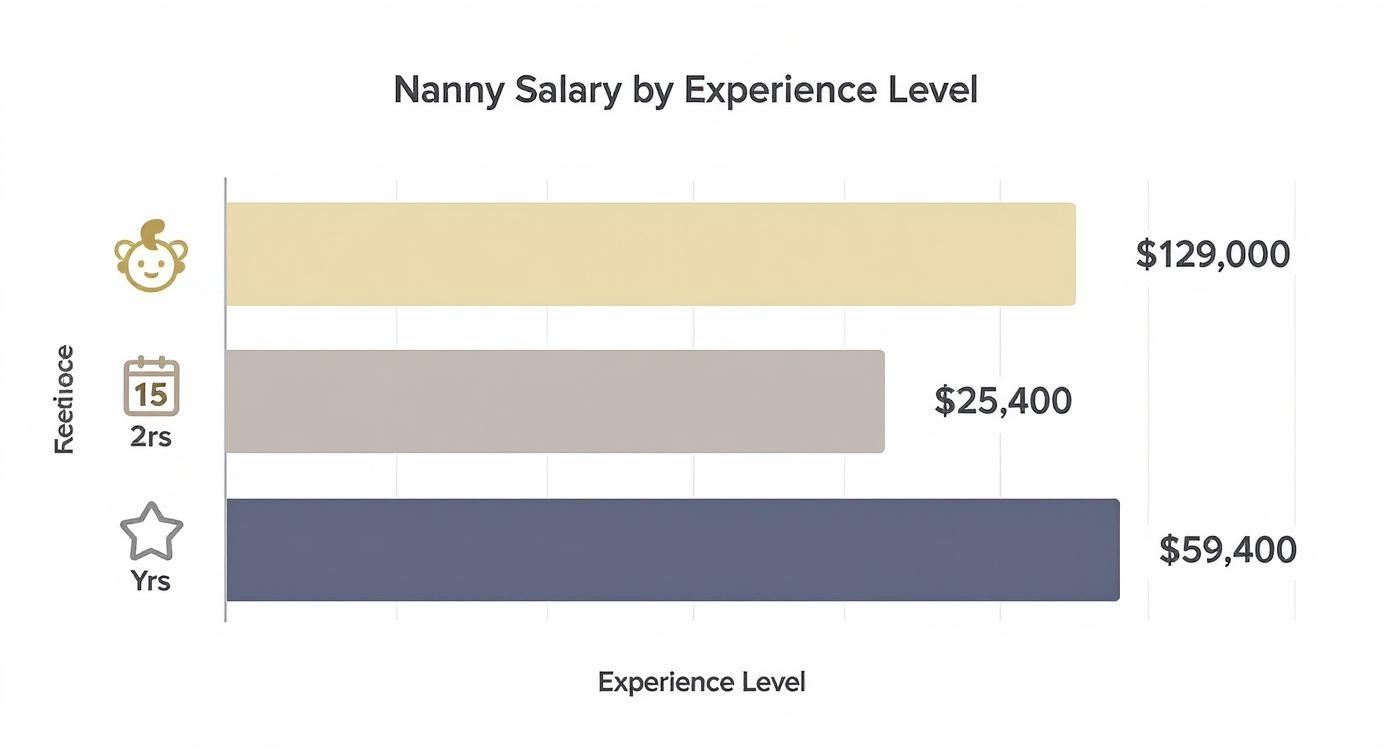
As the chart shows, nannies with over a decade of experience are in a completely different earning bracket, which just goes to show the premium that UHNW families place on seasoned, trusted professionals.
The Norland College Gold Standard
When you talk about elite childcare qualifications, Norland College is in a league of its own. A Norland Nanny, often called a ‘Norlander’, is recognised worldwide as the absolute pinnacle of the profession. Their intense, degree-level training is a unique blend of academic theory and practical, real-world skills. It covers everything from developmental psychology and advanced first aid to evasive driving and cyber-security.
For many UHNW families, hiring a Norland Nanny isn’t just about finding childcare. It’s about securing an unparalleled standard of excellence, discretion, and holistic child development. That famous brown uniform has become a symbol of trust and capability that commands the highest respect—and salaries—in the industry.
While Norland is the ultimate credential, other highly respected qualifications can also give your profile a serious boost. A CACHE diploma, for example, is recognised globally and shows you have a strong, practical foundation in early years education and care.
Must-Have Certifications to Boost Your Profile
Beyond your main educational background, it’s the specialist certifications that really make your CV compelling. These extra skills show families that you’re proactive, safety-conscious, and dedicated to being the best you can be. Think of them as essential tools in your professional toolkit.
To really stand out when applying for Dubai nanny jobs, make sure you’re certified in these key areas:
- Paediatric First Aid & CPR: This is completely non-negotiable for almost every family. It shows you can respond calmly and correctly in an emergency, which is a source of huge reassurance for parents.
- Early Childhood Development: Qualifications in frameworks like Montessori or the Early Years Foundation Stage (EYFS) prove you can create a stimulating, educational, and fun environment for young children.
- Child Protection & Safeguarding: This training is absolutely vital. It shows you understand the protocols for keeping children safe from harm and can spot potential risks.
- Special Needs Care: If you have experience or qualifications in caring for children with special educational needs (SEN) or specific medical conditions, you become an invaluable asset to families who need that specialist support.
Each of these certifications adds another layer to your professional identity. You’re no longer just a caregiver; you’re a multi-skilled expert in child-rearing. And that well-rounded skill set is precisely what discerning families in Dubai are looking for.
Getting to Grips with Visas, Contracts, and Your Rights
Let’s talk about the legal side of things. I know paperwork can feel a bit daunting, but understanding how contracts and visas work in Dubai is your best tool for feeling secure and confident in a new role.
This isn’t about getting lost in red tape. It’s about knowing exactly what your rights are—and what your employer’s responsibilities are—from the very beginning. The system here is actually set up to protect you, so being well-informed means you can start your new job on the right foot.
The whole legal framework for domestic staff, including nannies, is built on the UAE Domestic Workers Law. Think of this as your rulebook; it clearly lays out everything from working hours to annual leave. Knowing what’s in it will give you total peace of mind when you sign on the dotted line.
How Sponsorship and Visas Actually Work
First things first: in Dubai, your employer is also your sponsor. This is a crucial point to understand. It’s not like a big company sponsoring you; the family you work for personally takes on the legal responsibility for your visa and residency. This is standard practice and a necessary part of the process for any private household role.
The family will handle your domestic worker visa, get you registered for a labour card, and coordinate with the immigration authorities. It might sound like a few extra steps, but these procedures are there to make sure everything is above board and compliant with UAE law, giving you a solid layer of legal protection.
Once you’ve accepted an offer, the process generally looks something like this:
- Entry Permit: Your employer arranges this so you can legally enter the country to start your job.
- Medical Fitness Test: After you arrive, you’ll have a mandatory medical screening to check for certain communicable diseases. It’s a standard procedure for all new residents.
- Emirates ID Registration: Next, you’ll get your Emirates ID card. This is your official identification document in the UAE, and you’ll use it for almost everything.
- Visa Stamping: The final step is getting the residence visa stamped into your passport. This officially confirms your legal status to live and work in the UAE.
Your Employment Contract: The Non-Negotiables
Your employment contract is the most important document you’ll sign. It’s a legally binding agreement that protects both you and your employer by making sure everyone is on the same page. For a more detailed look, this guide on the UAE employment contract is a great resource.
Crucially, your contract must be written in both English and Arabic and then officially registered with the authorities. My number one piece of advice? Never, ever start work without a signed copy in your hands.
Think of your contract as the blueprint for your professional relationship. A good one leaves no room for doubt and clearly defines every part of your job, preventing any misunderstandings down the road.
Before you sign anything, run through this checklist to make sure your contract includes clear clauses on these essential points. This is your chance to ensure the terms are fair and align with UAE law.
- Job Title and Duties: Is your role clearly described? Do you know exactly what’s expected of you?
- Salary and Payment: It should state your exact monthly salary, the currency, and the date you’ll be paid each month.
- Working Hours: The law states your hours shouldn’t exceed 12 hours per day. Make sure this is reflected.
- Rest Periods: You are legally entitled to 12 hours of rest per day, with at least 8 of those hours being consecutive.
- Days Off: You must be given at least one paid day off per week.
- Annual Leave: Check that it specifies your entitlement to 30 days of paid annual leave each year.
- Benefits: Details covering your accommodation, medical insurance, annual flights home, and anything else you’ve agreed upon should be in writing.
- End-of-Service Gratuity: This is your end-of-service pay, which you’re entitled to by law. The contract should confirm this.
- Notice Period: It should state the notice period required from both you and your employer if you decide to part ways.
By making sure all these elements are clearly defined, you’re building a professional foundation based on transparency and respect. It lets you get on with what you do best—providing truly exceptional care.
Crafting Your CV and Mastering the Interview
Applying for a top nanny role with a high-net-worth family in Dubai is a world away from your average childcare application. This isn’t just about listing your duties; it’s about proving you have the professionalism, discretion, and deep understanding that these unique households demand.
Think of your CV as your professional ambassador. It has to speak volumes about your capabilities long before you ever walk into an interview. For UHNW families, qualities like absolute trustworthiness and discretion are non-negotiable, and your application is their very first test.
Structuring a CV That Stands Out
To get noticed by a discerning family or their Chief of Staff, your CV needs to be immaculate. It must showcase your most valuable assets—your experience, qualifications, and specific skills—in a way that’s both impressive and incredibly easy to read. Generic templates just won’t cut it here.
The key is to frame your past roles as a series of accomplishments, not just a list of responsibilities. Don’t just say, “Responsible for children’s schedules.” Instead, try something like: “Orchestrated and managed complex daily schedules for three children aged 2, 5, and 8, seamlessly integrating educational activities, language tuition, and sporting commitments, which created a harmonious and productive household routine.” This small change in perspective demonstrates the real-world, positive impact you made.
It’s always a good idea to look at some high-quality childcare resume examples to get a feel for how to present your skills in the most powerful way.
The CVs that really work for top-tier Dubai nanny jobs are the ones that show results. How did you contribute to a child’s development? How did you improve their routine or support the family’s lifestyle? This evidence-based approach is what builds instant credibility.
A solid structure that works time and again for these exclusive roles looks something like this:
- Professional Summary: A short, punchy introduction that highlights your years of experience, key specialisms (like newborn care or the EYFS curriculum), and core values such as discretion and dedication.
- Key Skills: A bulleted list of your strongest abilities. Think paediatric first aid, bilingual communication, or specific experience with UHNW household protocols.
- Verifiable Experience: Lay out your work history, starting with the most recent role. Focus on your achievements in each position, not just the day-to-day duties.
- Education & Certifications: List your formal qualifications, from a Norland or CACHE diploma to essential safeguarding and first aid certificates.
- References: Simply state, “Impeccable, verifiable references are available upon request.” This protects the privacy of your previous employers—a sign of professionalism they’ll notice.
Acing the High-Stakes Interview
Once your CV gets your foot in the door, the interview is your chance to really connect. This is less a formal Q&A and more of a conversation to see if you’ll be a good fit for the family’s private, intimate home life. Your demeanour is just as critical as your answers. You need to project calm confidence, quiet professionalism, and unwavering trustworthiness.
You will, without a doubt, be asked about your childcare philosophy. Be ready to talk about your approach to discipline, education, and emotional support, using clear, thoughtful examples from your career. Families want to understand how you think and solve problems on your feet. Preparing by reviewing some common and tricky interview questions for nannies is time well spent.
Situational questions are a staple of these interviews. An employer might ask, “What would you do if one of the children had a tantrum in a public place?” They’re testing your judgement, your grace under pressure, and your discretion. Your answer should show a child-centred approach while also being keenly aware of the family’s public reputation.
Finally, cultural awareness is vital. You must show that you understand and respect local customs in Dubai. This touches on everything from your choice of interview attire to showing you grasp the importance of privacy. This awareness signals that you’re an adaptable, considerate professional who can integrate seamlessly into their household and the wider community.
What’s it Really Like to Be a Nanny in Dubai?

So, we’ve talked contracts and CVs, but what does a typical day actually look like? Being a nanny in Dubai isn’t just a job; it’s an invitation into the very heart of a family’s private life. It’s a role where your professional skills have to be matched by genuine empathy and unwavering discretion.
Picture this: your days are a mix of carefully planned routines and wonderful, spontaneous moments. You might be up early getting the children ready for school, followed by educational games with the toddler. Afternoons could be anything from coordinating playdates and supervising homework to exploring the incredible family attractions Dubai has to offer. It’s a dynamic role, for sure, and one that requires a lot of energy, but the rewards are immeasurable.
Thriving in a Private Household
Working so closely within a family’s home demands a keen sense of professional boundaries. It’s a delicate dance: you’re a trusted employee, but you’re also a huge part of the children’s world. Navigating this successfully takes real maturity and emotional intelligence.
You also have to be incredibly adaptable. One day might be a quiet one at home, but the next could see you packing for an international trip at a moment’s notice. It’s this combination of flexibility and absolute reliability that builds the deep trust so essential for a successful placement, especially in a high-profile household.
“The most important skill I’ve learned is to be a calm presence in the home. The family relies on you not just for childcare, but for creating a peaceful and stable environment. It’s about being observant, anticipating needs, and always, always respecting their privacy.”
Embracing the Expat Lifestyle
While your work is obviously the main reason you’re here, building a life for yourself outside the home is absolutely vital for your own happiness. Dubai has a fantastic, welcoming expat community, and finding your tribe is the key to truly feeling settled.
Connecting with other nannies and expats gives you an invaluable support network. These are the people who just get it. They provide a space to share stories, swap advice, or just unwind with friends who understand the unique pressures and joys of the job. Making an effort to build these connections will make all the difference in combating any potential feelings of isolation.
Finding Your Work-Life Balance
Let’s be honest: achieving a healthy work-life balance can be the biggest challenge, but it’s non-negotiable for a long and happy career. With Dubai nanny jobs, especially live-in positions, the lines between ‘on’ and ‘off’ can easily become blurred.
Here are a few practical tips I’ve learned over the years:
- Guard Your Time Off: When it’s your day off, make it count. Truly switch off. Go explore the city, take up a hobby, and give yourself a proper chance to recharge.
- Communicate Clearly: From the very beginning, have an open conversation with your employer about working hours and personal time. Clear expectations prevent misunderstandings later.
- Create Your Own Rituals: Build a personal routine that has nothing to do with work. It could be a morning run on the beach or a weekly video call with your family back home. These things ground you.
At the end of the day, being a nanny in Dubai is so much more than a career move—it’s a genuine life experience. It will push you and help you grow in ways you never expected, all while creating memories and relationships that will stay with you forever.
Common Questions About Dubai Nanny Jobs
Thinking about a nanny job in Dubai? It’s a big move, and naturally, you’ll have a lot of questions. I get it. To help clear things up and get you started on the right foot, let’s go through some of the most common queries I see from nannies considering a role in the UAE.
What Are the Typical Working Hours for a Live-In Nanny?
Let’s be clear: being a live-in nanny in Dubai is a demanding role. You can generally expect to work 10 to 12 hours a day, often six days a week. It’s a significant commitment, and families expect a high level of dedication.
However, it’s not a free-for-all. Your rights are protected under the UAE Domestic Workers Law, which is something you absolutely need to be aware of. The law is very specific: you are legally entitled to at least one full day off each week.
The law also guarantees you a daily rest period of 12 hours, with at least eight of those hours being consecutive and uninterrupted. All of this – your working hours, breaks, and your day off – should be spelled out clearly in your contract. No ambiguity, no “we’ll see how it goes.”
Do I Need to Speak Arabic to Be a Nanny in Dubai?
This is a question I hear all the time. The short answer is no, speaking Arabic is not essential for most nanny positions in Dubai. The city is a huge international hub, and a large number of roles are with expatriate families who communicate primarily in English.
That said, picking up a few basic Arabic phrases will make your life a lot easier and more enjoyable. It helps with everything from grabbing groceries to building a rapport with other staff in the household. If you’re looking to work with an Emirati family, knowing some Arabic will definitely make your CV stand out and could give you an edge over other candidates.
How Do I Find Reputable Agencies for Placements?
Choosing the right agency is probably the single most important step you’ll take. Your best bet is to focus on agencies that specialise in placing high-calibre household staff, particularly for international positions. They understand the market and the expectations of UHNW families.
Here’s the golden rule from my years of experience: a reputable agency will never, ever charge you a fee to find you a job. The family always pays the agency fees. If an agency asks you for money, walk away.
Spend time doing your homework. Look for online reviews and testimonials from other nannies. A good agency won’t just find you a job; they’ll properly vet both you and the family, help you navigate the contract, and support you through the entire visa process. It’s all about ensuring the placement is secure and a great fit for everyone involved.
At Superstar Nannies, we specialise in connecting exceptional childcare professionals with elite families in Dubai and worldwide. We understand the nuances of these unique roles and are dedicated to finding placements that are the perfect fit for both you and the family. Explore our vetted opportunities and take the next step in your professional journey by visiting us at https://superstarnannies.com.